
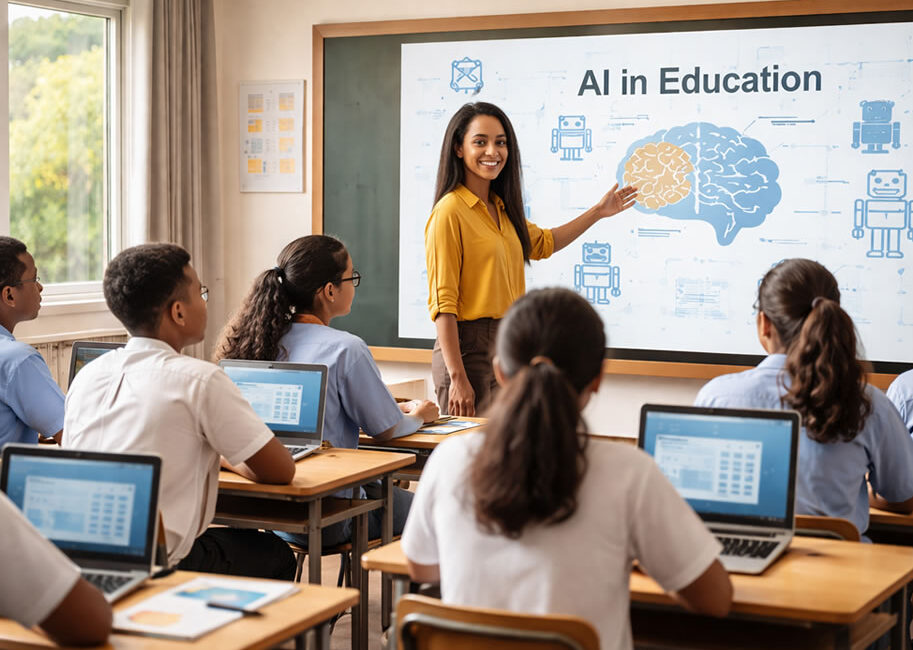
Artificial Intelligence is no longer a future concept in education. It is already here. From helping students write essays to assisting teachers with lesson planning, AI tools are quickly becoming part of everyday learning around the world.
But here is the real question:
Is AI improving education or quietly weakening it?
Recent global discussions, including reports covered by NPR and insights from education leaders, suggest the answer is not so simple.
What AI is already doing in classrooms
Across schools worldwide, AI is being used in very practical ways:
- Helping students understand difficult concepts faster
- Giving instant feedback on writing
- Supporting multilingual learners through translation
- Allowing personalised learning based on student level
- Saving teachers time on repetitive tasks like grading or lesson preparation
In short, AI is acting as a support system, not a replacement for teachers.
And that is an important distinction.
The big concern: Are the risks bigger than the benefits?
According to a global study highlighted by NPR, the risks of AI in education currently outweigh the benefits, at least for now.
Researchers warn that AI can:
- Undermine foundational learning skills
- Reduce critical thinking
- Encourage over-reliance on technology
- Create confusion around what students actually understand
In simple terms, if students rely too much on AI, they may stop learning how to think independently.
The over-reliance problem
Education leaders are already seeing this in classrooms.
AI tools can make learning easier, sometimes too easy.
- Students may skip the effort needed to solve problems
- Writing tools can generate answers instead of developing ideas
- Learning becomes more about output than understanding
AI should support learning, not replace the thinking process.
Teachers are still central (and more important than ever)
One strong point both sources agree on is that AI works best only when guided by good teachers.
AI can save time, provide insights, and assist with content, but it cannot replace human judgment, emotional support, or real teaching experience.
In fact, the success of AI in schools depends heavily on teacher training, clear policies, and responsible use. Without that, AI creates more confusion than value.
What this means for Mauritius
Mauritius is already pushing digital transformation in education, with tablets, online platforms, and smart classrooms. AI will naturally be the next step.
But there are some realities we must consider.
Digital divide is still real. Not all students have equal access to devices or stable internet. AI could help top-performing schools move faster, but it could also widen the gap with others.
There is also a lack of clear AI policies. Globally, schools are still figuring out what is allowed, what counts as cheating, and how to use AI responsibly. Mauritius is not yet fully structured on this either.
Another factor is our exam-focused education system. If AI is misused, students may depend on it instead of mastering concepts. Results may improve, but real understanding may drop.
So what should Mauritius do?
Instead of blindly adopting AI, the smarter path is balance.
Focus on AI literacy. Students need to understand how AI works, its limits, and when not to use it.
Train teachers first. AI is only effective if teachers know how to use it properly.
Use AI for support, not shortcuts. It should help with practice, feedback, and explanations, not do the work for students.
Build clear guidelines. Schools need structured rules around assignments, exams, and acceptable AI use.
Final thought
AI is not the enemy of education. But it is not the solution either.
It is a tool, and its impact depends on how we use it.
For Mauritius, the challenge is not whether AI will enter classrooms. It already has.
The real challenge is whether we will use it to empower students or let it replace their thinking.
Disclaimer:
The information provided in this article is for general informational purposes only. While efforts have been made to ensure accuracy, no guarantees are made regarding completeness or reliability. Readers are encouraged to verify information independently and consult relevant professionals or authorities where appropriate.

