
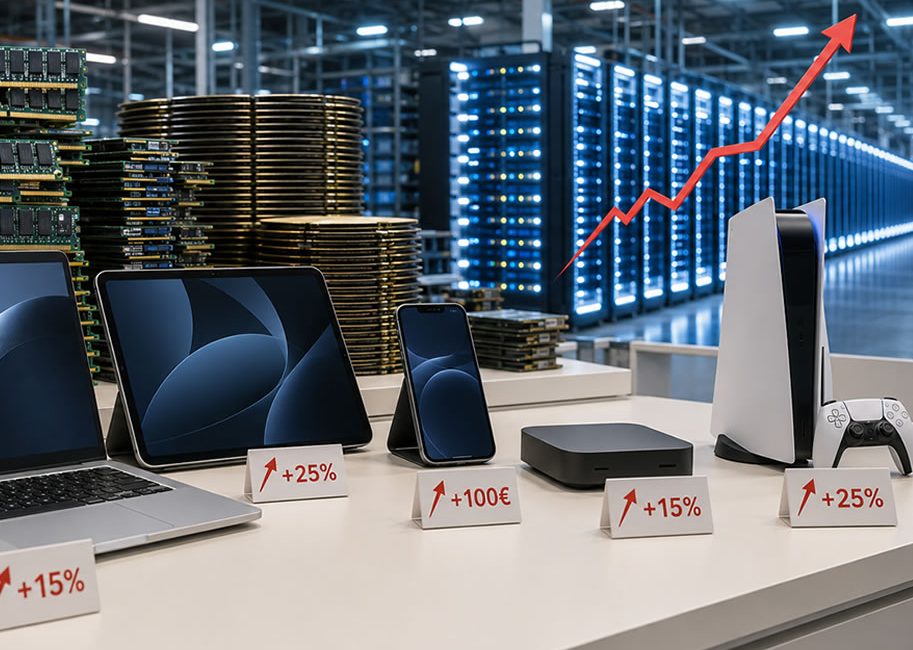
On 25 June 2026, Apple raised its prices. In the middle of the year. With no new product to justify it. Macs, iPads, the Apple TV: up 15 to 25%, just like that.
Apple never does this. This is the company that held its prices through Covid shortages and through the 2025 trade war. Their explanation, in their own words: they had never seen component prices climb this much, this fast, and they could no longer absorb the cost. The stock lost 6.1% that day. 263 billion dollars gone in one session.
And Apple was not even first in line:
- Sony raised the PlayStation 5 by 100 euros in March
- Nintendo announced the Switch 2 going up to 499.99 euros from September
- Dell, HP, Lenovo and Asus all raised laptop prices
- Samsung added 100 dollars to two Galaxy S26 models
So no, it is not just you. Everything with a chip in it is getting more expensive at the same time. Here in Mauritius, where every phone, laptop and console arrives by boat with freight and duty on top, you feel it even harder.
The question is why. And the answer is a war over tiny memory chips being fought thousands of kilometres away, to feed the biggest business bet ever made.
The short version
Every time you ask ChatGPT a question, your phone does none of the work. Your phone is a screen with Wi-Fi. The actual thinking happens in a giant warehouse full of expensive chips, called a data center.
Tech giants are now building these warehouses at a pace nobody has ever attempted:
- One large AI data center holds around 100,000 specialised chips
- Each chip costs roughly 30,000 to 40,000 dollars
- Chips alone: 3 to 4 billion dollars per building
- Add power, cooling and construction, and one site costs more than 10 billion dollars
Microsoft, Google, Amazon and Meta are expected to spend close to 700 billion dollars on this in 2026. That is more than the entire economy of most countries. In one year. On warehouses.
How that becomes YOUR problem
Those data centers need enormous amounts of memory. And memory is exactly what your laptop, your phone and your PlayStation are made of.
Three companies (Samsung, SK Hynix and Micron) make about 90% of the world’s memory chips. In the last two years they faced a simple choice: keep selling ordinary memory to Apple, Dell and Sony, or sell a special high-end version to AI data centers, which pay far more per chip.
They did what any business does. They followed the money. The fallout:
- Memory prices up 90 to 95% in one year (TrendForce, Q1 2026)
- Storage chips up 55 to 60% over the same period
- Gartner expects no real relief before late 2027
The industry even has a nickname for it: the RAMageddon. There is only so much memory to go around, the AI warehouses are outbidding everyone for it, and device makers pass the difference to you. You are paying for the AI buildout every time you buy a device, whether you use AI or not.
Here is the part almost nobody talks about
All that spending only makes sense if AI eventually earns enough to pay for it. So how is that going?
J.P. Morgan did the math. For this investment to earn even a modest 10% return, AI would need to bring in about 650 billion dollars of revenue every single year, forever.
To picture that number, their own comparisons:
- Every iPhone owner on Earth paying an extra 35 dollars per month, forever
- Or every Netflix subscriber paying an extra 180 dollars per month, forever
Nobody is paying anything close to that. The leading AI companies earn tens of billions a year, not hundreds. And companies that tried adopting AI at work are struggling too: an MIT study found that around 95% of enterprise AI projects were failing to produce measurable financial returns.
Meanwhile the tech giants keep spending. In 2023 they put about a third of their available cash back into AI infrastructure. In 2026 it is roughly 93%. Out of every dollar they earn, 93 cents goes back into the warehouses. They have even started borrowing to keep building.
This has happened before
In the late 1990s, everyone knew the internet was the future. So telecom companies spent over 500 billion dollars burying fiber optic cables across America, betting that internet traffic would grow forever.
They were right about the internet. They still lost everything:
- Internet traffic grew fast, just not as fast as the money assumed
- By 2002, only about 7% of the installed fiber was actually carrying data
- The crash wiped out around 2 trillion dollars of market value
- WorldCom filed what was then the biggest bankruptcy in US history; Global Crossing, once worth 47 billion dollars, went bankrupt too
The twist: the cables stayed in the ground. A few years later YouTube, streaming and the cloud arrived and ran on that abandoned fiber, bought for cents on the dollar by the survivors. The technology won. The companies that built it died anyway.
That is the fear hanging over AI right now. J.P. Morgan wrote it themselves: their biggest worry is a repeat of the fiber story.
So is it a bubble?
Honest answer: nobody knows, and anyone who sounds certain is guessing.
The case for worry:
- Spending is 9 to 10 times bigger than what AI currently earns
- The giants are betting nearly all their cash on one assumption
- June 2026 gave a taste of what a correction feels like: one bad day on 5 June erased 1.3 trillion dollars from chip stocks worldwide
The case for calm:
- Unlike the fiber companies of 1999, Nvidia, Microsoft and Google are hugely profitable
- Today’s data centers are being used the moment they open, not sitting empty
- Stock valuations are high, but nowhere near the madness of the dot-com era
The technology is real. The bet is on the price being paid to build it.
What it means for you, concretely
Your devices stay expensive. The memory shortage runs at least into 2027. If you were planning to replace a laptop or phone, the maths of waiting just changed.
Cheap AI may not stay cheap. If the giants need to justify their spending, the price of using AI goes up. The nearly free tools that students, freelancers and small businesses in Mauritius rely on today could become the first casualty. Enjoy the subsidised era while it lasts.
Understanding this is worth money. Whether the bet pays off or cracks, the people who understand how AI actually works and what it actually costs will make better calls than the people reading headlines. That applies to buying a laptop, picking a career skill, or choosing which AI tool to build a business on.
You did not sign up for the biggest bet in tech history. But the moment prices went up on 25 June, you became part of it.

