
Your child finishes an essay in twenty minutes, and it is cleaner than anything they have handed in all term. You are proud for about ten seconds. Then you start to wonder where it actually came from.
That moment is happening in a lot of homes in Mauritius right now. ChatGPT is free, it is on every phone, and children have worked out how to use it long before most parents have. So the question lands sooner or later: when my child uses ChatGPT for homework, is that cheating, or is it learning?
The honest answer is that it can be either. Same tool, completely different outcomes, and the difference is entirely in how it gets used.
It helps to know how normal this already is. In the United States, where the figures are clearest, the share of teenagers using ChatGPT for schoolwork doubled in a single year, and by the most recent surveys more than half of teens say they use AI chatbots to help with school (Pew Research Center). There is little reason to think Mauritius is far behind. What is interesting is that the children themselves draw a line: most are comfortable using it to research a topic, but far fewer think it is acceptable to have it write a whole essay for them. Even they sense where learning ends and copying begins.
A teacher told us about a Form 4 boy whose English essays suddenly started reading like something off a university reading list. Tidy arguments, vocabulary out of nowhere. She was pleased at first. Then one afternoon she asked him to explain one of his own points to the class, and he just sat there. He could not do it. The essay was brilliant and the boy had got nothing out of writing it, because he had not really written it. And here is the uncomfortable part she admitted: for a few weeks she had been marking those essays highly. It had not just fooled the parents. It had fooled her.
When it is cheating
The clearest case is copy and paste. The child types the question in, takes the answer, and hands it over without understanding a word of it. The homework looks done. Nothing has actually gone into their head.
This is the version that should worry parents, and not mainly because it breaks a rule. It is a problem because of how exams still work here. PSAC, SC and HSC are sat by hand, on paper, with no phone in sight. A student who has leaned on ChatGPT all year to produce work they cannot reproduce alone walks into that exam hall with nothing. The marks they were getting on homework were never really theirs.
So the danger is not that AI makes a child dishonest. It is that it lets them feel like they are learning when they are not.
When it is learning
Now the other side, because it is just as real.
A child who uses ChatGPT well does not ask it for the answer. They ask it to explain. They get stuck on a maths step and ask why it works. They write a paragraph themselves and ask whether the argument holds up. They ask it to set five more practice questions on a topic they keep getting wrong, then do them on their own. Used like that, it behaves a lot like a patient tutor who never gets tired and never makes them feel stupid for asking again.
That is genuine AI homework help, and it can teach a child more than a rushed evening with a worksheet. The skill, the thing they are quietly building, is knowing how to ask, how to check, and when not to trust the answer. That skill has a name. It is digital literacy, and it is going to matter for the rest of their life, not just their schooling.
The line, in one sentence
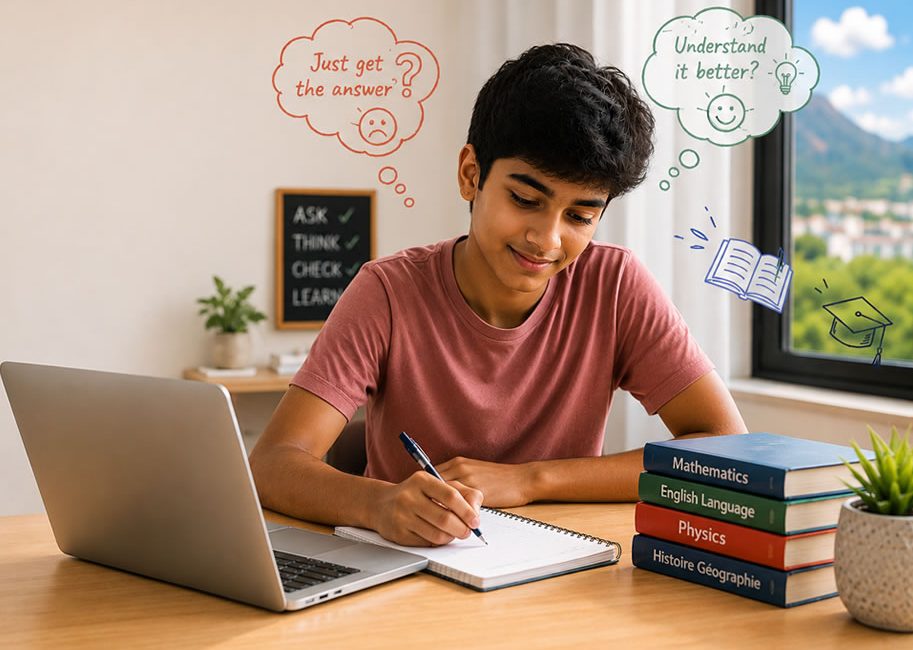
If the tool does the thinking, it is cheating. If it helps your child do the thinking, it is learning.
Everything else is detail. A child who understands their finished homework has learned. A child who could not explain a single line of it has not, no matter how good it looks on the page.
What parents can actually do
Banning it usually does not work. The phone goes back on the moment you leave the room, and you have just taught your child to hide it from you instead of talking to you about it. This is more or less the conclusion the experts reached too. When ChatGPT first appeared, plenty of schools simply blocked it, but UNESCO, in its first global guidance on generative AI in education, pushed the other way: not a ban, but ground rules, adult oversight, and a recommended minimum age of 13 for children using these tools on their own. The reasoning was simple. You cannot wall a child off from something this widespread. You have to teach them to handle it.
A better move is simple. Ask them to explain their homework to you, out loud, without the screen. Not as an interrogation, just a normal question. A child who used AI to understand the work will be able to. A child who copied it will stumble within a sentence or two, and now you both know where the real gap is.
The bigger job is teaching them how to use it properly. Show them the difference between asking for an answer and asking for an explanation. Make checking a habit, since AI can state something completely wrong with total confidence, a problem known as hallucination. A child who learns to question the answer is in a far stronger position than one who was simply told never to touch it.
So where does that leave ChatGPT?
Here is the thing. ChatGPT does not care whether your child actually learns the topic or just gets the homework off their plate. That is not really a flaw. It was never meant to be a teacher. It is a general tool, and it will hand over a finished answer the second someone asks for one.
That is the real difference with a proper learning platform. The whole point of one is to get the child to the understanding, not just to the answer. It nudges them toward working it out themselves, it sticks to the actual PSAC, SC and HSC syllabus instead of some generic version, and it lets a parent see how things are genuinely going.
That gap is what we are trying to fill at Bright, built around the way children here study and sit their exams. We wrote about the bigger picture in our look at digital educational platforms in Mauritius.
The short version
AI is not going away, and pretending your child will never touch it is not a plan. The realistic goal is not to keep them away from ChatGPT. It is to make sure that when they use it, they come away understanding more, not less.
Get that right and it is one of the most useful tools a student has ever had. Get it wrong and it is an expensive way to learn nothing. The tool is the same. The child’s habits are what decide which one you end up with.
Sources and further reading
- UNESCO, Guidance for Generative AI in Education and Research (2023), and Governments must quickly regulate generative AI in schools.
- Pew Research Center, About a quarter of US teens have used ChatGPT for schoolwork, double the share in 2023 and How teens use and view AI.
Disclaimer:
The information provided in this article is for general informational purposes only. While efforts have been made to ensure accuracy, no guarantees are made regarding completeness or reliability. Readers are encouraged to verify information independently and consult relevant professionals or authorities where appropriate.

