
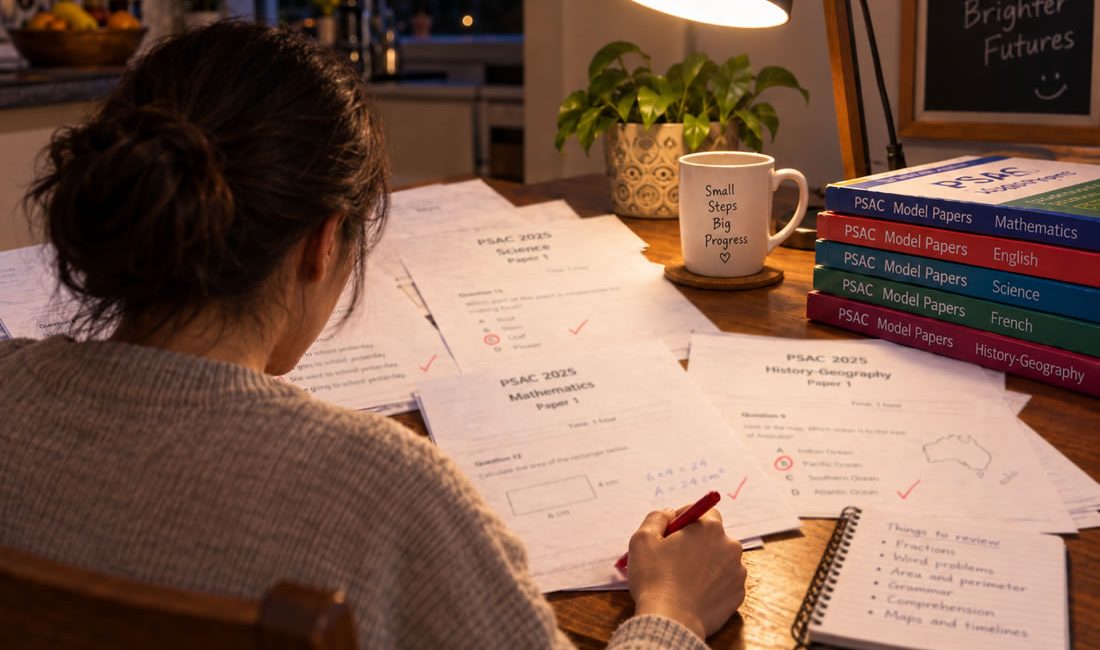
Walk into any bookshop in Mauritius around this time of year and you will see the same thing, which is parents buying model papers by the armful. Not one book but four or five, sometimes more, covering Maths, English, French and Science, with a couple of revision books added on top. Then they go home and download every PSAC past paper they can find, because the free ones are just as good and there is no reason not to have both.
A lot of families do exactly this, and there is good reason for it. Working through paper after paper in the last few months before the exam is one of the most useful things a Grade 6 child can do, and most teachers will tell you the same.
The exam is close now, with the papers starting towards the end of October, which leaves most families somewhere between six and eight weeks of real revision time. If you are still looking for the papers themselves, the Mauritius Examinations Syndicate publishes PSAC Grade 6 question papers online for free, sorted by subject and by year, so it makes sense to start there before you spend anything at the bookshop.
So the papers come out, your child sits down after school and starts working, and that part of the arrangement usually goes fine. The problem starts once the paper is finished.
The papers work, the correction is where it breaks
A paper only helps if your child finds out what went wrong while the question is still fresh in his head, because the whole value of practice sits in that short window where he tries something, gets it wrong, sees why, and tries again. In most Mauritian homes that window closes long before anybody gets to the correction.
Your child finishes a paper at five in the afternoon, you get home some time after six, and then there is dinner to sort out and homework due the next morning, so the paper does not get looked at until much later in the evening. By the time you reach question 34, nobody in the house is thinking about question 34 anymore, which means you are no longer correcting a live mistake but simply announcing a result on something he has already let go of. He nods, you move on, and very little of it actually stays.
Correcting on the same day matters far more than most parents realise, and it has nothing to do with being organised or quick. It is that a child forgets what he was thinking when he chose that particular answer, and once that thinking is gone, the correction stops being a lesson and becomes just another piece of information.
When you cannot answer the question yourself
Then there are the questions you cannot do, and every parent hits them eventually.
Grade 6 Maths is harder than most of us remember, and the difficulty is usually not the answer but the method, because the way it is taught now is often not the way you learned it twenty or thirty years ago. You explain it your way, your child tells you that is not how the teacher does it, and rather than confuse him further you stop and say you will ask the teacher instead, which is the honest thing to do.
The trouble is that if the next chance to ask is a few days away, the question simply waits, and by the time you get there you have three or four new ones and only enough time to raise the worst of them. Do that for two months and you end up with a quiet pile of questions that nobody ever closed, not because anyone was careless, but because there is no fast way to reach a teacher when a child is stuck at a table at five in the afternoon.
The list that never survives
Parents who take this seriously usually start a list, and the instinct behind it is exactly right. Every time your child gets something wrong you write it down, so that three weeks before the exam you can put the full papers aside and go back over only the things that keep going wrong.
The hard part is keeping that list useful for six or eight weeks. It ends up spread across a notebook, the margins of the papers themselves, and a few notes on your phone, written in a shorthand that made sense at the time. Paper 4 question 12, the fractions one, that word problem about the bus. By October none of it means anything, because you can no longer see which topics keep coming back and which were just a bad afternoon, and you certainly cannot tell whether the fractions problem last month was the same fractions problem from the month before.
So you end up with a record that is no use to you, and after all that effort you still cannot answer the one question that actually matters, which is what is still going wrong and how often. The information was there the whole time. There was just no way to hold it.
The backlog nobody warns you about
The other thing that catches parents out is that a child can finish papers considerably faster than a working parent can correct them.
Three papers over a weekend is nothing much for a child who is trying, but one parent coming home tired after work cannot mark three papers properly and still explain what went wrong in each of them, so the pile quietly grows through the week. And because your child depends on you for the correction, your backlog turns into his stop sign, so he asks whether you have checked Sunday’s paper, you have not, and he either waits or starts another paper on top of the ones already sitting there unmarked, which only makes the situation worse.
The bottleneck was never his effort. It is your evenings, and his revision ends up moving at whatever speed you can mark, which in a normal working week is slow.
What you can actually find online in Mauritius
There is plenty available, and all of it is worth using. MES puts past PSAC papers online for free, sites like Mauritius Papers hold Grade 6 papers going back to 2017, bookshops sell model papers written by people who know this exam properly, and social media there are Mauritian teachers working through entire past papers question by question, which genuinely helps at nine at night when you are stuck on something.
Most of those resources solve the first problem very well, which is getting good practice material in front of your child. What they do not solve is the second one, which is keeping track of the mistakes over time and turning them into the next thing to revise. There are digital platforms available to Mauritian families as well, and most of them are built around delivering lessons and content rather than following what one particular child keeps getting wrong week after week.
Would an online practice platform help?
Yes, and it is worth being clear about why, because the answer is not that the papers or the books are the weak point in this system.
A practice platform that worked properly would need to do three things, none of them complicated. It would tell your child straight away whether the answer was right, at five in the afternoon rather than at nine at night when the thinking has gone. It would keep the record for you, sorted by topic rather than by paper, so that nobody has to maintain a notebook that stops making sense after a month. And it would bring the same kind of question back a week or two later, so that you can see whether he genuinely understood it or simply got that one right on the day.
None of that replaces the teacher or the books, and it should not try to. What it does is take the marking off the parent, which is the one job in this whole arrangement that has no business sitting with someone who walks through the door at six. That is also a reasonable way to judge any app you are paying for, and it is worth understanding what an AI learning platform actually does before you spend money on one. If the tools you already use do not do those three things, you can still build most of the same system by hand.
What to do in the weeks that are left
Correct on the same day even if you only get through five questions, because five questions gone over while the paper is still fresh will do more for your child than a complete paper marked on Saturday morning.
Do fewer papers and repeat more of them, since two papers a week worked through properly will teach him more than five that sit in a pile unmarked, and a question redone three days later tells you something real about whether he understood it, whereas a brand new paper mostly tells you the same thing you already knew.
Keep one list, on one page, sorted by topic instead of by paper, so that you write “long division with remainder” rather than “paper 4 question 12” and add a mark next to it every time the same thing comes back. In the last three weeks before the exam, that single page is the only thing you really need.
Ask the teacher in batches rather than one question at a time, collecting them through the week and handing over five together, because teachers here are stretched and a clear written list will always get you a better answer than a message sent at ten at night.
And keep an eye on where the answers are coming from, because a child can now pull a full worked solution off a phone in about ten seconds, which leaves you with no idea which questions he actually solved himself. There is a real difference between getting help and when a child gets the answer without doing the thinking.
The part that is missing
Mauritius has good papers and good teachers, and that side of things was never really the problem. What is missing is the bit in between, something that tells your child the answer is wrong while he still cares about it, holds the record without anyone keeping a notebook, and puts the question back in front of him before the exam rather than after.
Until that exists in a form most families can use, the list does the job well enough. One page, organised by topic, with one mark added each time the same mistake comes back, is worth more to you in the last three weeks than the entire pile of finished papers sitting behind it.

