
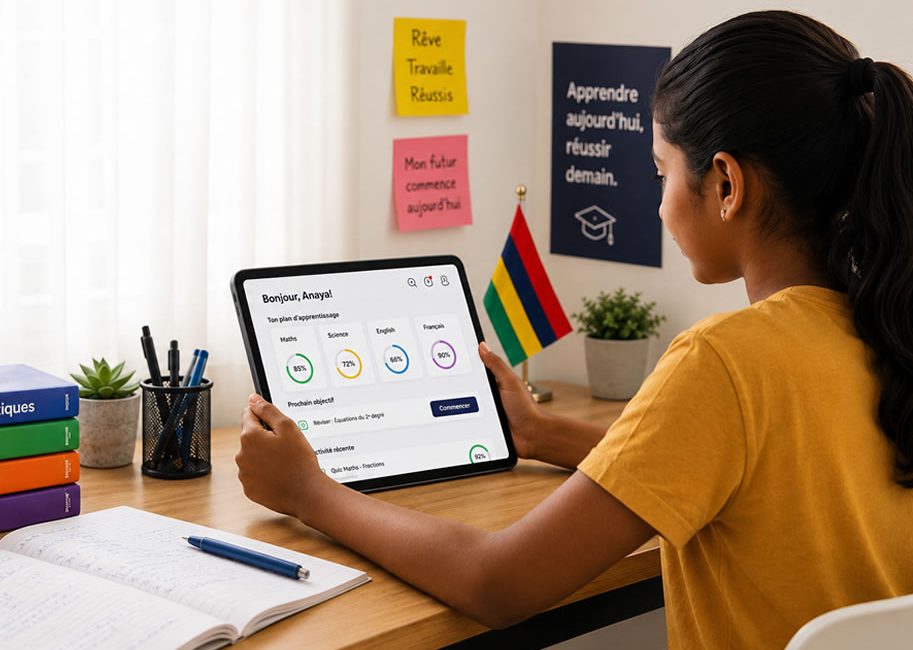
Most families in Mauritius spend a serious amount of money on private tuition. Between PSAC at the end of primary, then SC and HSC later, the leçons add up. Several subjects a week, year after year. For a lot of parents it ends up being one of the biggest costs of raising a child, sometimes more than school itself.
So when people say a digital educational platform in Mauritius is going to change how children learn, the question most parents are really asking is a practical one. Can a platform do what a good tutor does, and maybe cost less?
That is worth keeping in mind for the rest of this.
What a digital educational platform actually is
It is an online space where a student learns, a teacher teaches, and a parent can check how things are going, all in one place. Lessons, exercises, quizzes, feedback. Opened on a phone or a tablet.
The basic kind just puts the textbook on a screen. The useful kind does more. It adjusts to the child. A student who already gets a topic moves on, and one who is stuck gets more practice and a clearer explanation. A printed book cannot do that. One teacher with forty pupils mostly cannot either.
Mauritius has been building toward this for years
This did not come out of nowhere. A lot of the groundwork is already done.
Interactive projectors went into primary classrooms under the Sankoré project. Tablets were handed out to young pupils through the Early Digital Learning Program in Mauritius, Rodrigues and Agalega. Schools and libraries were connected with Wi-Fi and proper bandwidth through SchoolNet. All of it sits under Digital Mauritius 2030, the government plan to get fast internet across the island and make digital tools part of normal life.
The reason that history matters is simple. A platform is only as good as what sits underneath it: devices, a connection, teachers who know how to use them. Mauritius has spent years on that base, which is the only reason the next step is realistic at all.
Why AI changes the picture
For a long time, “digital education” here mostly meant reading the same material on a screen instead of on paper. Useful for some students, but not a big shift.
AI is what actually moves things. The country has already run a first test, the mytGPT pilot by Mauritius Telecom and the Ministry of Education, with a small group of Grade 12 students in Rodrigues. We wrote about it in the mytGPT pilot project, and about the wider trend in AI in education in Mauritius. It is a good start.
A pilot is still just a pilot, though. What counts is where an AI learning platform lands once it grows past the trial.
What the good ones will do for your child
This is the part that matters if you are the one paying for tuition.
A proper AI learning platform builds a study plan around your child, the topics they handle fine and the ones they keep missing. It can generate new practice questions whenever they need them, so revision is not the same past paper photocopied again and again. When an answer is wrong, it shows where the thinking went off, not only that a mark was lost.
It also keeps track of the right things. It notices which topics a child keeps failing and turns that into a clear picture of where they stand. A parent can see real progress without hovering. A teacher can catch the weak spots sooner. And it stays tied to the Mauritian curriculum, so the time spent counts toward PSAC, SC or HSC, not some generic foreign syllabus.
The idea is to give a child the kind of one-to-one attention that, until now, only families who could afford private tutors really got.
A few Mauritian projects are already working on exactly this, Bright among them, an AI learning platform built around the Mauritian curriculum and exams.
The problems nobody should pretend away
None of this happens by itself, and it is fair to be honest about the gaps.
First, access. A platform is no help to a child who cannot get online or does not have a device. Unless connectivity keeps spreading, it mainly benefits the families who were already ahead.
Second, accuracy. AI sometimes gives wrong answers with complete confidence. The technical word is hallucination. For a young student who cannot tell the difference, that is a real risk, and it is why teacher oversight and curriculum checks are not optional extras.
Third, the obvious one. AI should help the teacher, not replace them. Ask most teachers in Mauritius and they will tell you the same.
Where this is heading
The pieces are mostly there. The infrastructure, a national plan that runs to 2030, a population that is largely online, and the first pilots showing schools and parents are interested.
What comes next will be settled by trust more than by features. The platforms that last will be the ones that stay close to the curriculum, protect student data, keep teachers in the loop, and actually improve results. Personalised study plans, adaptive practice, honest progress tracking and real exam preparation are what will separate a serious tool from a gimmick.
Digital educational platforms are not something on the way to Mauritius. They are already here. The real question is who builds them well, and whether they are built for our classrooms, our curriculum and our exams. That is the challenge we are working on at Bright.
Disclaimer:
The information provided in this article is for general informational purposes only. While efforts have been made to ensure accuracy, no guarantees are made regarding completeness or reliability. Readers are encouraged to verify information independently and consult relevant professionals or authorities where appropriate.

