
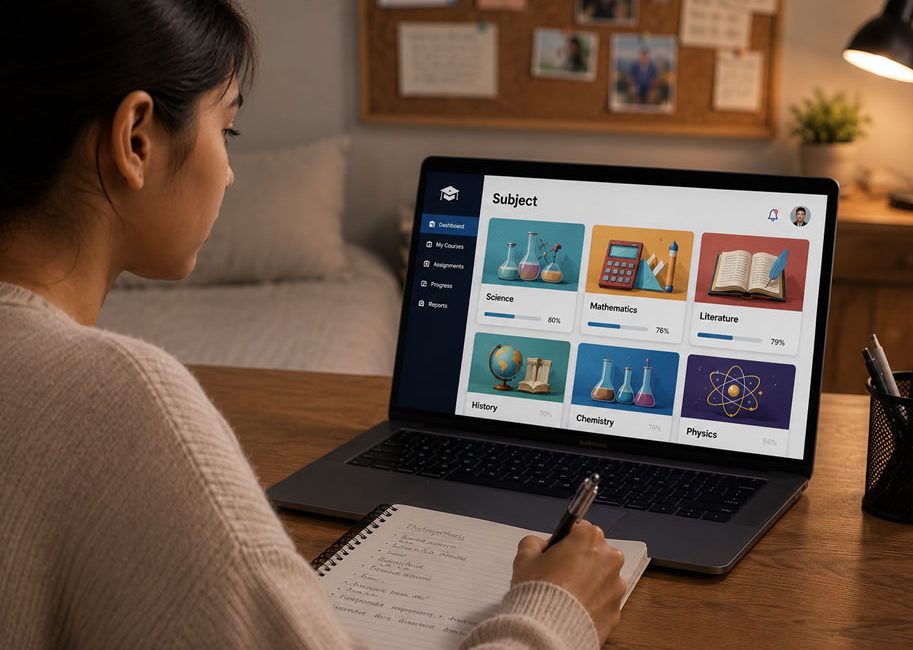
Spend a few minutes reading about how children are supposed to study these days and you keep hitting the same words. AI learning platform. AI tutor. Adaptive learning. Personalised learning. They get thrown around as if everyone already knows what they mean. Most parents do not, and that is fair enough, because half the people using the words are not too sure either.
So here is a plain explanation. No jargon. What an AI learning platform actually is, how it works, and whether it is worth your time.
Start with what it is not
A friend paid for a full year of something advertised as an AI learning platform. What showed up was a library of recorded video lessons and a stack of multiple-choice quizzes. Her son watched two videos and never opened it again. She had basically bought a digital textbook with a clever name on it.
That is worth saying first, because a lot of what gets sold as an AI learning platform, or an AI education platform, is really just content sitting on a screen. Videos. PDFs. The same set of questions for every child who logs in. It might be useful, but there is nothing clever about it. It does not know your child, and it does the same thing whether they are top of the class or completely lost.
A real AI learning platform is the opposite of one size fits all.
So what is it, really?
At its simplest, it is an online tool that teaches a student, adjusts to them as it goes, and keeps track of how they are doing.
Imagine a tutor who is there every evening after school, who remembers every mistake your child made last month, and who can pull up another practice question the moment they get stuck. That is roughly the idea. You will sometimes see the same thing called an AI tutor, and for a parent the two words mean much the same thing.
The word that does the real work here is adapt.
How does an AI learning platform work?
In practice it does three things, and the middle one is what matters.
It teaches and sets work, the same as any study tool. Fine. Nothing new there.
Then it changes based on how the child answers. This is the adaptive part, and it is the whole point. Get something right and it moves you on. Get it wrong and it slows down, explains it a different way, and gives more practice on that exact weak spot until it sticks. A class of forty pupils cannot do that for one child. A private tutor can, for an hour a week. A good platform aims to do it every time the child sits down with it. That is what people mean when they say adaptive learning or a personalised learning platform. It is not a slogan, it is just the software paying attention.
And it remembers. Over weeks it builds a picture of where your child is strong and where they keep slipping, and it shows that to you and to the teacher. For most parents that is the rarest thing of all, an honest read on how a child is actually doing, instead of waiting for a report card three months too late.
Is it better than a tutor?
It depends, and anyone who tells you a platform flat-out beats a good human tutor is overselling.
A human reads a child in a way software cannot. They notice the bad mood, the nerves before exams, the subject the child has quietly given up on. What a platform does better is the grind. Endless practice, instant feedback, available every evening, for one fixed price instead of an hourly rate. For a lot of families the sensible answer is not one or the other but both, the platform for the daily work and a tutor kept for the subject that genuinely needs a person. We went into that properly in our piece on whether AI can reduce private tuition costs in Mauritius.
The Mauritian part most platforms get wrong
Here is the catch with most of the big names. They are built for American, British or Indian syllabuses. The maths a child practises, the way an essay is marked, the topics that come up, none of it lines up cleanly with what our children actually sit.
That is why curriculum-aligned learning is not a small detail. An online learning platform is only useful here if the work on it counts toward PSAC, SC and HSC rather than some foreign version of the subject. A child can spend hours on a slick foreign app and still walk into the exam hall under-prepared, because the app was quietly teaching to a different test.
This is exactly the gap a few Mauritian projects are now working to fill, with platforms shaped around our own curriculum and the exams children here actually face. If you want the wider view, we set it out in our overview of digital educational platforms in Mauritius.
How to tell a real one from a dressed-up textbook
If you do go looking for the best AI learning platform for your child, you do not need to understand the technology. You just need to ask a few blunt questions.
Does it actually adapt, or is it videos and quizzes with a fancy label? Does it follow the Mauritian curriculum, or a foreign one? Does it show you real progress, not just a score? And the one test that beats all the others: after using it, can your child explain what they just learned, in their own words, with the screen off? If they can, the platform is doing its job. If they cannot, it is no better than the homework copying we wrote about in ChatGPT and homework.
An AI learning platform is not magic, and it is not a replacement for effort. At its best it is a patient, tireless tutor that knows your child, can cost significantly less than regular one-to-one tuition, and is there whenever they sit down to work. That is genuinely new, and for students in Mauritius it is worth understanding rather than dismissing as more tech noise.

